Buying Property in Mallorca in 2026: Process, Taxes & Costs
A step-by-step route from mortgage and NIE to legal checks, completion and Balearic property taxes, with a €600,000 resale example. · 11 min read

Buying property in Mallorca begins with choosing a way of life, but succeeds through careful paperwork. A stone house in the Tramuntana, a Palma apartment and a coastal villa can involve very different practical questions. This 2026 guide follows the purchase from budget to registered ownership, with the taxes separated from the other costs.
Start with the home you actually need, rather than the photograph you cannot stop looking at. Think about winter use, access, maintenance and whether you want to walk to everyday essentials. Then assemble your team before you sign or transfer a reservation payment.
- Choose your purpose: permanent home, occasional use or a property with an independently verified rental entitlement.
- Compare a total acquisition budget, not just asking prices; keep renovation and annual ownership costs separate.
- Explore Palma, Puerto Portals and Camp de Mar alongside Port de Sóller and Santanyí.
- Appoint an independent lawyer and, where the building warrants it, an architect or surveyor.
1. Set your budget and mortgage for buying property in Mallorca
Build your budget in three layers: purchase price, acquisition expenses and money needed after the keys arrive. Tax is usually the largest additional item, but legal work, notarial and registry charges, valuation, finance and currency conversion also deserve their own lines. A single percentage allowance can hide expensive differences between a resale and a developer’s first delivery.
If borrowing, establish what a lender will consider before committing to contractual dates. Ask for the available loan amount, valuation basis, repayment terms and the documents needed for your income and residence profile. An initial borrowing indication is not an unconditional mortgage offer; your contract should reflect any finance dependency.
Keep purchase costs distinct from mortgage-deed costs. For mortgages within Spain’s residential mortgage-credit framework, the lender bears the mortgage’s notarial, registry and management expenses and the borrower pays the valuation; mortgage stamp duty is borne by the lender. That does not remove the buyer’s separate purchase taxes or purchase-deed expenses (Notariado).
2. Arrange your NIE and banking
Your NIE is Spain’s foreigner identification number, not a residence permit. For the NIE Mallorca purchase process, Policía Nacional lists form EX15 and proof of payment of fee form 790, code 012. Explain the economic reason for applying. Applications can be made through the designated police or immigration offices; applicants outside Spain can use Spanish consular offices (Policía Nacional).
Arrange the payment route and bank compliance early. Ask your chosen bank what identity, tax-residence and source-of-funds evidence it requires, and agree how completion funds will reach the seller. A Spanish account can be useful for ownership bills, but do not confuse a convenient banking arrangement with a universal legal requirement to open one. Keep a clear documentary trail for the deposit and final payment.
3. Find the property, then check what you are buying
Before paying a deposit, have your lawyer obtain a recent nota simple. This identifies the registered property, ownership and recorded charges. It is informative rather than conclusive evidence: a registry certification provides authoritative proof of the register’s contents. Match the seller and property details to the documents rather than relying on a listing description (Registradores).
Ask for the cédula de habitabilidad, energy certificate, relevant building and occupation documentation, and the planning history. The cédula concerns habitability: it should not replace a planning investigation. Have the architect compare the house, terraces, pool and outbuildings on site with the approved plans and official descriptions. Balearic habitability requirements are set out in Decree 145/1997.
For rustic land, establish the land classification, lawful residential use, access rights, water supply and wastewater arrangements. A registered building is not, by itself, a promise that you may extend it, rebuild it or add a pool. Assess the existing works and your intended changes under the Balearic rural-land law and the applicable planning instruments.
On the coast, investigate the maritime-terrestrial public-domain boundary, easements and any concession affecting the property. A sea view and a freehold home are not interchangeable legal descriptions. Spain’s Coastal Law can restrict occupation and works independently of the normal planning rules.
Treat tourist-rental income as a separate due-diligence exercise. The Govern’s containment measures prohibit new tourist places in multi-family residential buildings. For any claimed existing entitlement, your lawyer should establish the registration, permitted capacity, conditions, duration where relevant and what happens on a change of owner. A purchase does not create a rental licence (Govern Balear).
For an apartment or shared development, obtain the community debt certificate, statutes and recent meeting minutes. Look for approved major works, disputes and restrictions relevant to your plans. For any home, ask for the latest IBI receipt and arrange an independent building inspection where appropriate; the legal file and physical condition answer different questions.
4. Review the reservation and arras contract
A reservation agreement and an arras contract are not harmless preliminaries. Private agreements can bind you before the notarial deed, and an arras agreement is not compulsory. Have your lawyer identify the parties, property, price, deposit holder, completion date, conditions and consequences of default before signing (Notariado).
The familiar rule that the buyer loses the deposit or the seller returns double belongs to expressly agreed withdrawal-type arras, not every payment labelled a deposit. Specify any finance condition, documents the seller must supply, mortgage cancellation arrangements, vacant possession and included contents. There is no need to present a customary deposit percentage as a statutory requirement.
5. Complete before the notary and register ownership
The notary checks identity, authority and the legal transaction, explains the deed and records the payment arrangements. The notary is impartial, not a substitute for your own property investigation. If you will not attend, arrange a suitable power of attorney in advance; if you do not understand the deed’s language, organise proper language assistance (Notariado).
Before the appointment, agree the completion statement, cleared funds, cancellation of existing charges, handover and keys. After signing, ensure the deed is submitted to the Land Registry and the relevant taxes are filed. Obtain the registered deed and final expense reconciliation, then transfer utilities, community contact details and local billing arrangements. Completion day is a milestone, not the end of administration.
6. Pay purchase taxes and plan annual costs
For an ordinary resale, the buyer pays ITP. The current general Balearic marginal bands are 8% on the first €400,000; 9% on €400,000–€600,000; 10% on €600,000–€1 million; 12% on €1 million–€2 million; and 13% above €2 million. These are slices, not one rate applied to the whole price (ATIB).
Worked example — a €600,000 resale: €400,000 × 8% = €32,000; remaining €200,000 × 9% = €18,000. Total ITP = €50,000, an effective rate of 8.333%. Price plus ITP is €650,000 before legal, notarial, registry and other expenses. This assumes the taxable value is €600,000 and no relief applies.
The price is not necessarily the final ITP tax base: the statutory reference-value rules can produce a higher taxable amount. Have the adviser check the applicable value before committing. Reduced rates and reliefs have detailed eligibility rules, including habitual-home conditions; do not assume a holiday home qualifies. Use the current Balearic tax legislation alongside ATIB’s guidance.
A developer’s first delivery of an ordinary new dwelling generally attracts 10% IVA rather than resale ITP. The legal classification of the delivery matters, not simply whether the property looks new (Agencia Tributaria).
Budget AJD on the purchase deed as well: the Balearic general rate is 1.5%, with 2% for qualifying property transfers where the relevant real or higher declared value is at least €1 million. On a straightforward €600,000 first-delivery dwelling with a €600,000 AJD base and no relief, IVA is €60,000 and AJD €9,000: €69,000 combined (BOE, articles 15 and 17).
Notarial and registry charges follow regulated tariffs, rather than one universal fee for every home. Request an itemised estimate and separate any professional management fees. Municipal plusvalía on an ordinary paid sale is generally the seller’s tax; where the seller is a non-resident individual, the buyer can be the statutory substitute taxpayer. Agree how this will be handled, rather than assuming the contract removes the buyer’s exposure (Notariado).
Annual costs include municipal IBI, community charges where applicable, insurance, maintenance and services. Non-resident individual owners can also owe income tax on imputed income for an urban home kept for personal use or empty, even without rent. The base generally uses 1.1% or 2% of cadastral value, subject to the valuation rules; the tax rate is generally 19% for qualifying EU/EEA residents and 24% for others (Agencia Tributaria).
7. Non-EU buyers: ownership is not residence
Spain ended new investor-residence applications under the golden-visa regime on 3 April 2025. Transitional provisions protect qualifying earlier applications and existing permissions. Buying a property in 2026 does not open a new golden-visa route: plan any long-term residence separately (Organic Law 1/2025).
Non-EU buyers should also ask whether prior military authorisation applies to the particular property. Spain’s defence-zone legislation restricts certain foreign acquisitions, with exemptions and detailed territorial rules; this is especially important to resolve before fixing completion dates on rural purchases (BOE).
8. Brexit and UK buyer notes
British buyers should distinguish ownership, immigration status and tax residence. The UK is a third country, while qualifying Withdrawal Agreement beneficiaries retain protected rights. Owning a home does not itself extend visitor permission (Ministerio del Interior). Budget sterling-to-euro movements and assess the non-resident tax treatment by actual tax residence, not passport alone.
Who you’ll need
Choose professionals for the specific work, with scope and fees agreed in writing. These MBook-listed firms describe the relevant services on their live official websites; inclusion is not a promise of a particular result.
- Legal: Garrigues has a Palma team advising non-resident investors (official site); EM Legis handles Spanish property purchases, particularly Mallorca (official site).
- Legal and administration: Ortega i Adrover lists purchase checks, deed assistance, taxes and registration (official site). Global Consulting Mallorca offers real-estate legal work and tax services.
- Finance: aFinance offers mortgage intermediation (official site); Lionsgate Capital arranges Spanish property finance (official site). Neither mention guarantees loan approval.
- Property search: First Mallorca markets island-wide property (official site); Mallorca Dream Homes focuses on Sóller and the north-west (official site); Prestige Villas offers property sales in the north (official site).
Practical tips before you commit
- Keep one shared checklist covering finance, legal checks, building inspection, deadlines and completion funds.
- Require written answers about alterations, licences and rental rights; do not substitute advertising language for documents.
- Keep purchase taxes, annual ownership taxes and any future rental taxation in separate budgets.
How much is purchase tax on a €600,000 resale?
Under the general Balearic ITP scale, it is €50,000: €32,000 on the first €400,000 and €18,000 on the remaining €200,000. This assumes a €600,000 taxable value and no relief. Legal work, purchase-deed charges, registration and any finance costs come on top.
Do I need a NIE to buy a house in Mallorca?
Foreign buyers need their Spanish identification arrangements in place for the purchase and tax formalities. The NIE is the foreigner identification number, not permission to live in Spain. Start the application early using the official EX15 procedure, and coordinate its timing with your lawyer and bank.
Can I rent the property to holidaymakers?
Not simply because you own it. New tourist places in multi-family residential buildings are prohibited under the Govern’s containment measures. An advertised existing licence needs its own investigation, including capacity, conditions and change-of-owner requirements. Assess the purchase on verified lawful use, not a projected holiday-rental spreadsheet.
Does buying a home give me a golden visa?
No new golden-visa application can be based on a 2026 purchase under the former investor regime. That route ended on 3 April 2025, with transitional arrangements for qualifying earlier cases. Property ownership and permission to reside remain separate questions, including for British and other non-EU buyers.
This is general information, not legal or tax advice.

Photo credits
- Historic stone country houses of Es Fangar among olive and pine woodland in rural Mallorca: Joan Miquel, CC BY-SA 3.0, via Wikimedia Commons (https://commons.wikimedia.org/wiki/File:Cases_des_Fangar.JPG)
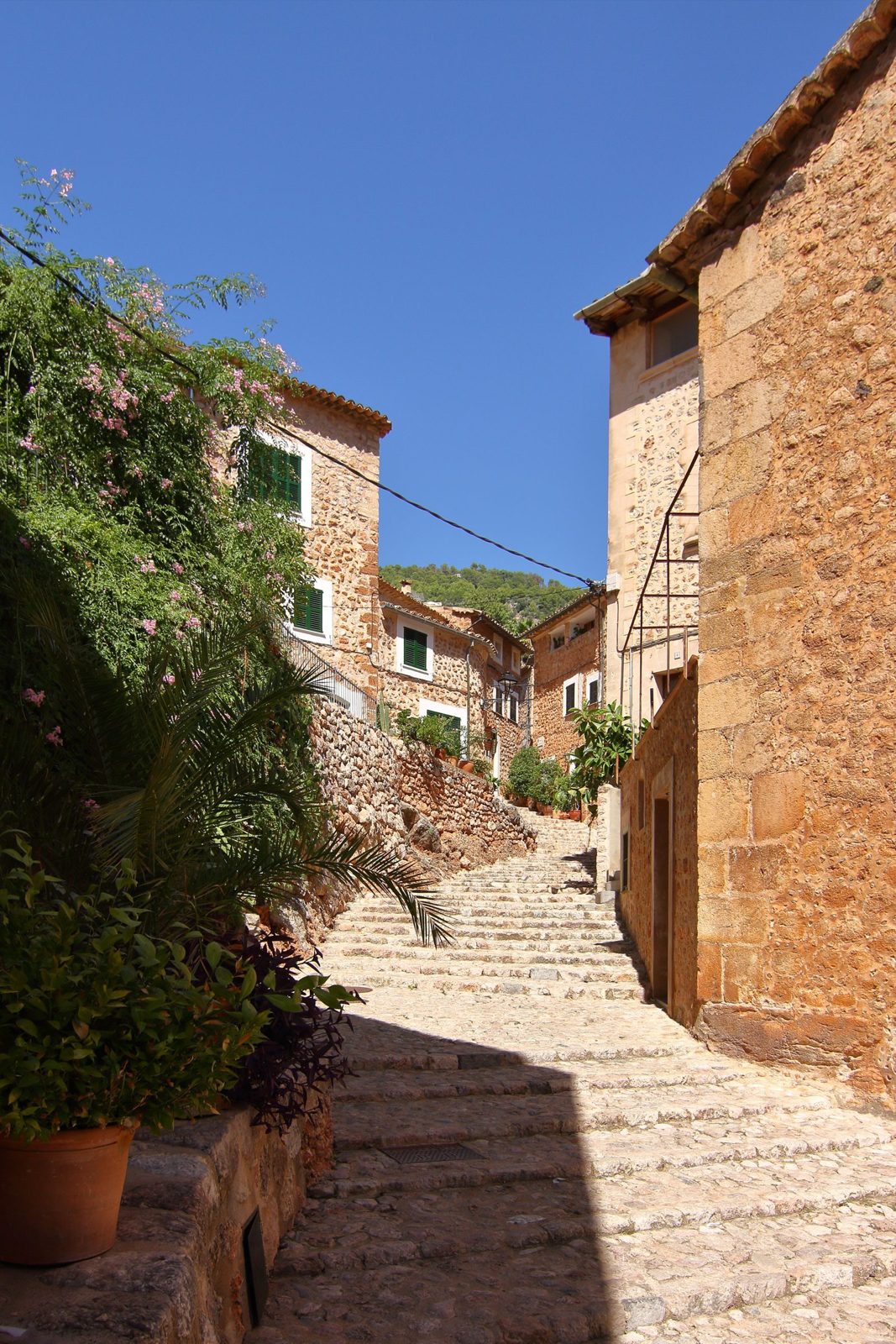
- Honey-coloured stone houses and steps along Carrer Església in Fornalutx: Malopez 21, CC BY-SA 4.0, via Wikimedia Commons (https://commons.wikimedia.org/wiki/File:Fornalutx,_Carrer_Esgl%C3%A9sia.jpg)
- Historic courtyard on Carrer Sant Francesc in Palma: Enric, CC BY-SA 4.0, via Wikimedia Commons (https://commons.wikimedia.org/wiki/File:152_Pati_al_c._Sant_Francesc_(Palma).jpg)